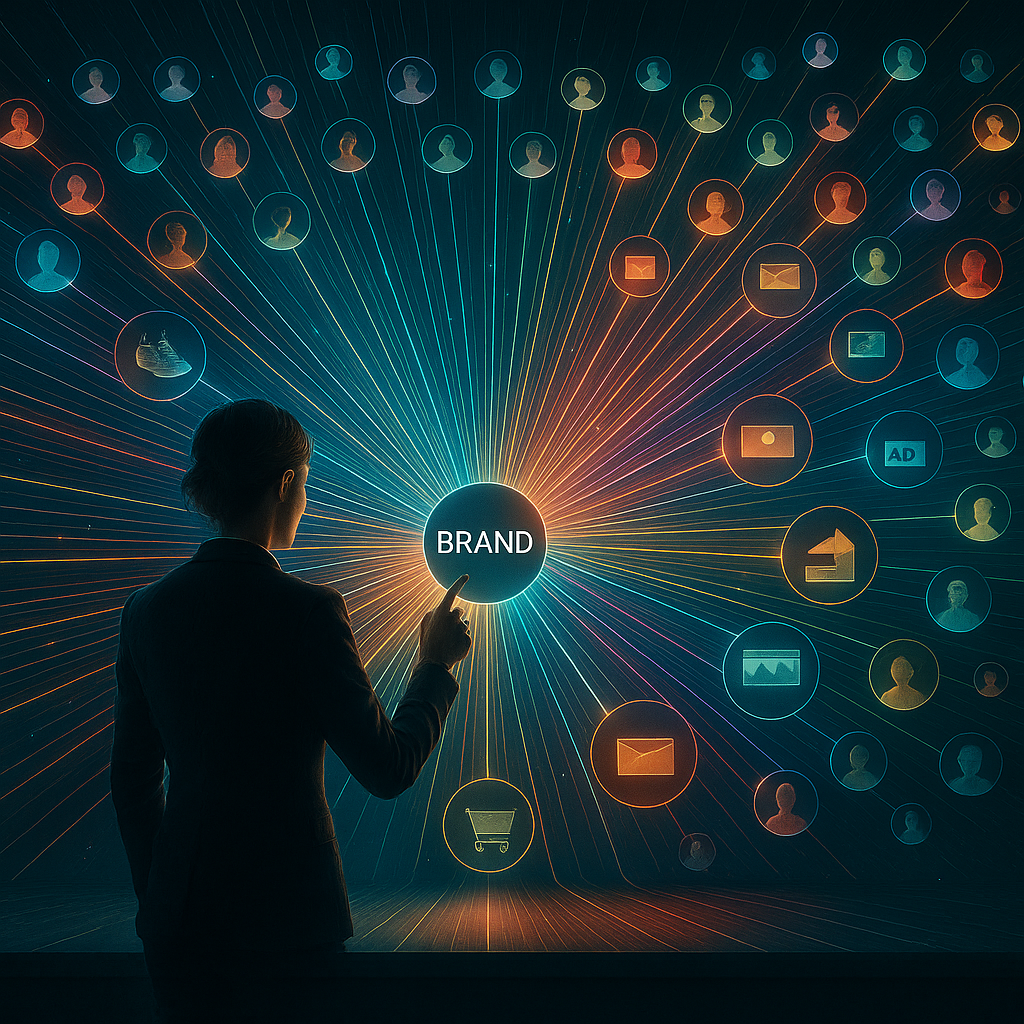
For decades, the holy grail of marketing has been the “segment of one”—the ability to treat every customer as a unique individual. Yet, for most of history, this has been an impossible dream. Businesses have settled for crude, demographic-based segments like “women aged 25-34” or “high-income urban males,” broadcasting generic messages to millions in the hope that they resonate with a few. This is not personalization; it is a slightly more focused form of spam.
That era of compromise is officially over. The convergence of two powerful technologies—Artificial Intelligence and the Customer Data Platform (CDP)—has finally made 1-to-1 personalization at scale a practical reality. This is the dawn of hyper-personalization: a new marketing paradigm where every touchpoint, from the products displayed on a website to the content of an email, is dynamically tailored to the individual’s real-time behavior and predicted needs.
This article is your playbook for this new world. We will demystify the technology, breaking down what a CDP is and the crucial role AI plays within it. We will then provide a step-by-step guide with actionable “plays” you can run to implement a hyper-personalization strategy that builds deeper customer relationships and drives significant revenue growth.
1. The Foundation: What is a Customer Data Platform (CDP) and Why Do You Need One?
Before AI can perform its magic, it needs a clean, unified source of data. This is the essential role of the Customer Data Platform.
Beyond the CRM: The Single Customer View Many businesses confuse a CDP with a Customer Relationship Management (CRM) platform. While both deal with customer data, their functions are different. A CRM is primarily a tool for managing interactions with customers (sales calls, support tickets). A CDP, on the other hand, is an intelligent data warehouse. Its sole purpose is to create a single, unified, and persistent profile for every customer.
A CDP ingests data from every single customer touchpoint:
-
Website Behavior: Pages visited, products viewed, time spent.
-
E-commerce Data: Purchase history, abandoned carts, lifetime value.
-
Mobile App Usage: Features used, session length.
-
Marketing Engagement: Emails opened, ads clicked.
-
Support & Sales: Support tickets, CRM data.
It then uses a process called “identity resolution” to stitch all these disparate data points together into one comprehensive “golden record” for each individual.
The Bedrock of Personalization You cannot personalize what you do not understand. Without a CDP, a customer’s data is fragmented across a dozen different systems that don’t talk to each other. The marketing team sees one version of the customer, and the support team sees another. A CDP breaks down these silos. It provides the clean, unified, and real-time data that is the essential fuel for any sophisticated AI engine. It is the bedrock upon which any true hyper-personalization strategy is built.
2. The Intelligence Layer: AI’s Role in the CDP
Once the CDP has unified the data, the AI layer can get to work, transforming raw data into actionable intelligence.
AI-Powered Micro-Segmentation Instead of manually creating a few broad segments, an AI-powered CDP can identify hundreds or even thousands of dynamic “micro-segments” based on subtle behavioral patterns. It can automatically group customers into segments like:
-
“High-LTV customers who are at risk of churning.”
-
“New visitors who have shown interest in a specific product category but haven’t purchased.”
-
“Price-sensitive shoppers who only buy during major sales events.”
-
“Brand loyalists who are likely to be interested in a new premium product.”
Predictive Analytics for LTV and Churn The most valuable function of the AI is its predictive capability. By analyzing the unified data of thousands of past customers, the AI learns to identify the key behaviors and attributes that lead to high Lifetime Value (LTV) or, conversely, to customer churn. It can then apply these models to every new customer, generating a predictive score. This allows businesses to focus their retention efforts on at-risk, high-value customers and tailor their acquisition strategies to attract prospects who resemble their best existing customers.
Next-Best-Action and Product Recommendations The AI doesn’t just analyze the past; it predicts the future. Based on a customer’s real-time browsing and historical purchase data, the AI engine can predict the next product they are most likely to buy, the next piece of content they are most likely to engage with, and the “next best action” the brand should take to move them along their journey. This is the engine that powers the hyper-personalized product recommendations you see on sites like Amazon and Netflix.
3. The Playbook: Implementing 1-to-1 Journeys at Scale
With the CDP collecting the data and the AI providing the intelligence, you can now run a series of “plays” to create hyper-personalized experiences across all your channels.
Play #1: The Personalized Website Experience
-
The Goal: Make every visitor feel like the website was designed just for them.
-
Execution: When a known customer logs in (or a visitor is identified via a cookie), the CDP informs the website of their segment and predictive scores. The website can then dynamically change its content. A visitor previously interested in hiking boots might see a homepage banner featuring mountain scenery, while a visitor interested in running shoes sees an urban running scene. The product listings can also be automatically re-sorted to show the most relevant items first.
Play #2: The Dynamic Email Campaign
-
The Goal: Move beyond generic “email blasts” to truly personal, 1-to-1 communication.
-
Execution: The AI triggers unique email flows based on individual behavior. For example, a standard abandoned cart email might just show the product. A hyper-personalized version could include a customer testimonial for that exact product, mention that it’s a “bestseller,” and perhaps offer a small, targeted discount if the AI has identified the user as “price-sensitive.”
Play #3: The Hyper-Targeted Ad Campaign
-
The Goal: Improve ad ROI by showing the perfect ad to the perfect person.
-
Execution: This is where you leverage your highest-value segments. You can sync your “High-LTV Customer” segment from your CDP directly to ad platforms like Google and Meta. This allows you to create incredibly powerful Lookalike Audiences based not just on all your customers, but on your absolute best ones, a strategy proven to increase ROI. You can also run remarketing campaigns that show an ad for the
exact product a user viewed, but with a different message depending on whether the AI has classified them as a “new prospect” or a “loyal customer.”
4. The Market Leaders: A Review of AI-Powered CDP Platforms
The CDP market is mature and filled with powerful options designed for different types of businesses.
1. The Developer’s Choice (e.g., Segment) Segment is an API-first platform that is beloved by developers for its flexibility and robust data infrastructure. It is the best choice for tech-savvy companies that want to build a custom, best-in-class data stack and have the engineering resources to manage it.
2. The Marketer’s Choice (e.g., Twilio Engage) Twilio Engage (which is built on top of Segment) is designed for marketing teams. It combines the powerful data unification of a CDP with the execution capabilities of a marketing automation platform, allowing marketers to build and manage personalized journeys within a single, more user-friendly interface.
3. The Enterprise Powerhouse (e.g., Treasure Data, Adobe Real-Time CDP) These platforms are built for the immense scale and complexity of large global enterprises. They offer the most advanced features for data governance, security, and integration with other enterprise systems, designed to manage hundreds of millions of customer profiles.
Conclusion: From Broadcasting to Conversation
The era of mass marketing is over. The philosophy of shouting a single message to millions of people and hoping for the best is an inefficient and expensive relic of the past. The future of business growth belongs to the organizations that can master the art and science of personalization at scale.
AI and Customer Data Platforms are the technologies that make this possible. They provide the infrastructure to listen to your customers, the intelligence to understand them, and the automation to respond to them as unique individuals. By adopting this playbook, businesses can move beyond a purely transactional model to a relational one. They can stop broadcasting to segments and start having a 1-to-1 conversation with each and every customer. The businesses that win the future will be those that use data not just to sell, but to understand and serve.
