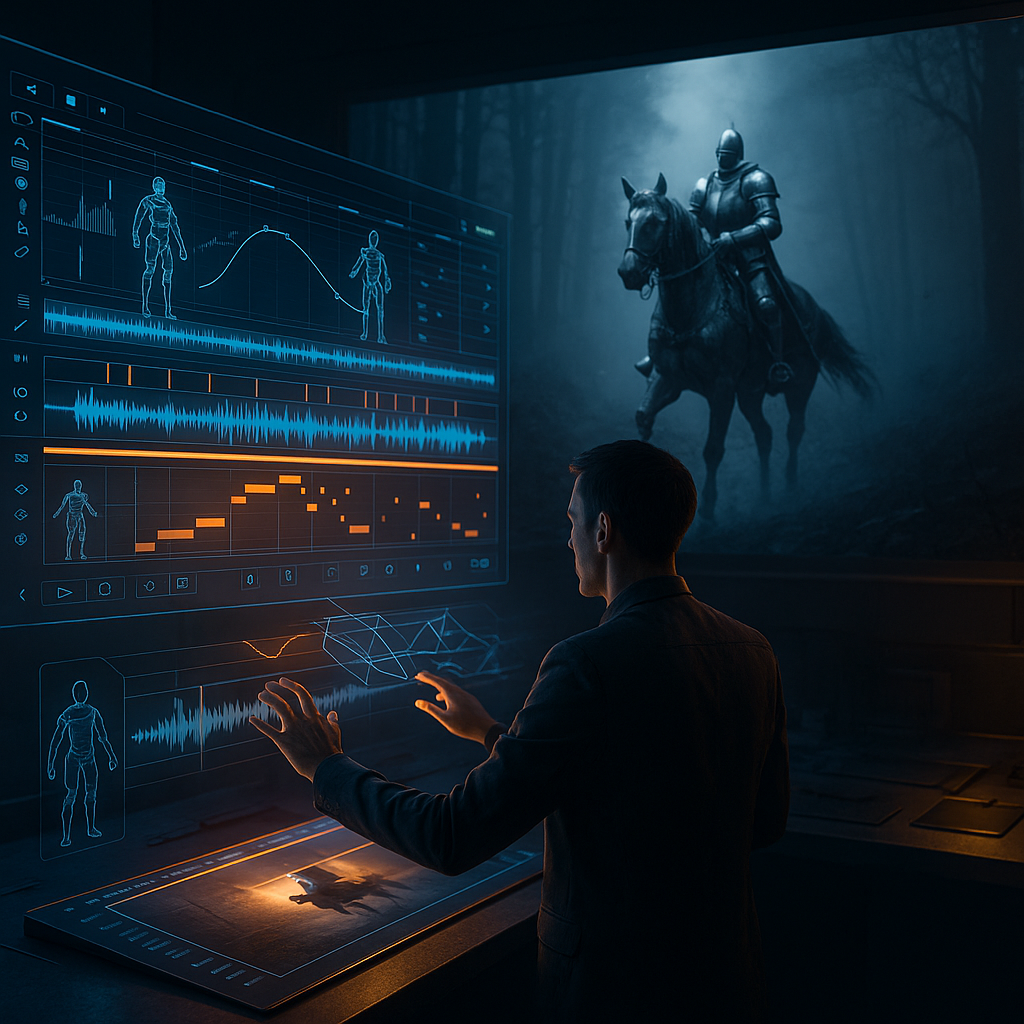
Just when the world caught its breath after the explosion in AI image generation, the next creative frontier emerged: text-to-video. The ability to evoke moving, cinematic worlds from a few lines of text—once the domain of science fiction—is now a tangible and rapidly evolving reality. This new technology promises to democratize filmmaking, supercharge marketing, and fundamentally reshape the landscape of visual storytelling.
But with this new wave of innovation comes a flood of hype, dazzling tech demos, and a confusing array of new platforms. For the filmmaker, the marketing agency, the visual effects artist, or the corporate creative, a crucial question arises: which of these tools is a fascinating toy, and which is a viable professional instrument?
This article is your definitive guide to that question. We will step into the AI Director’s Room and conduct a deep-dive comparison of the three undisputed leaders in the generative video space as of late 2025: OpenAI’s Sora, the benchmark for quality; Runway, the established creative suite for editors; and Luma Labs’ Dream Machine, the accessible and rapidly innovating newcomer. We will analyze their capabilities not as novelties, but as tools for cinematic creation, to help you decide which AI director is ready to join your crew.
1. The New Criteria: How to Judge an AI Video Generator
Evaluating AI video is a far more complex task than judging a static image. A single beautiful frame means nothing if the motion is incoherent. We have established five critical criteria to provide a fair and practical analysis for professional use cases.
- Cinematic Quality and Coherence: This goes beyond simple resolution. Does the model understand the physics of motion, the subtleties of light and shadow, and cinematic language? Crucially, for how many seconds can it maintain object permanence and logical consistency without characters or environments devolving into a surrealist mess?
- Controllability and Direction: How much power does the user have to act as a director? This includes the ability to dictate specific camera movements (pan, tilt, zoom, dolly), control the movement of subjects within the frame, and maintain character and style consistency across multiple clips.
- Accessibility and Workflow: How steep is the learning curve and how easily does the tool integrate into a professional pipeline? We evaluate the user interface, the speed of generation, and whether it can be used in conjunction with standard editing software like Adobe Premiere Pro or Final Cut Pro.
- Use Case Specialization: Is the tool a generalist, or does it excel at specific tasks? We evaluate its strengths for generating short, viral social media clips, abstract B-roll footage, narrative scenes, or product visualizations.
- Cost and Commercial Viability: What is the pricing model, and what are the terms of the commercial license? For any business, understanding the cost structure and the legal rights to the generated content is non-negotiable.
2. OpenAI’s Sora: The Unreleased Behemoth
First revealed in early 2024, OpenAI’s Sora remains the high-water mark for AI-generated video quality. Its initial demo videos were so shockingly realistic and coherent that they redefined the industry’s expectations overnight. Even in late 2025, it exists more as a powerful statement of intent than as a widely available tool.
- Cinematic Quality and Coherence (5/5): Sora’s output is, in a word, breathtaking. Its key differentiator is its deep, almost uncanny understanding of the physical world. It generates videos with a consistent sense of gravity, object interaction, and realistic lighting that other models struggle to replicate. Furthermore, its ability to generate clips up to a minute long while maintaining character and environmental coherence is a feat that sets it apart. In terms of pure, out-of-the-box cinematic realism, Sora is the undisputed benchmark.
- Controllability and Direction (3.5/5): Based on available information, Sora’s control is exercised primarily through highly detailed text prompts. Users can specify subjects, actions, settings, and even cinematic styles like “shot on 35mm film.” However, granular, user-guided control over specific camera movements or the precise path of a character is not yet a primary feature. The user acts as a scriptwriter and director of photography, but the AI does the “filming” with a degree of autonomy.
- Accessibility and Workflow (2/5): This remains Sora’s greatest weakness for the general public. As of this writing, access is still restricted to a small group of “red teamers,” visual artists, and high-end filmmaking partners. There is no public-facing interface or API. It is a tool for the studio, not for the masses—at least for now.
- Cost and Commercial Viability (3/5): The cost structure for Sora is still unknown. Given its immense computational requirements, it is expected to be a premium-priced product, likely targeting enterprise and studio clients first. OpenAI has confirmed that users will own the content they create, and its commercial use policy will likely mirror that of DALL-E 3, but the details have yet to be released.
Verdict:
- Who is it for? Currently, major film studios, VFX houses, and researchers. In the future, it aims to be the go-to tool for professional filmmakers and high-end advertising agencies.
- Choose Sora if: You have access to it and your only metric is achieving the highest possible cinematic quality and realism in a single generation.
3. Runway: The AI Creative Suite
Runway has been a pioneer in the AI video space for years, and its latest model, Gen-3, is a testament to its focus on building a practical and versatile toolkit for creative professionals. Runway’s philosophy is not just about video generation, but about augmenting the entire video editing process with a suite of AI “magic tools.”
- Cinematic Quality and Coherence (4/5): Runway’s Gen-3 model produces extremely high-quality and visually compelling video. While it may not always reach the hyper-realism of the best Sora demos, its output is consistent, artistic, and highly usable for professional projects. It excels at generating shorter clips (currently up to 10 seconds) with excellent detail and motion. It is particularly strong at creating stylized and surreal visuals, perfect for music videos and social media content.
- Controllability and Direction (4.5/5): This is where Runway truly shines. It is built from the ground up for directors and editors who need control. Key features include:
- Advanced Camera Controls: The ability to explicitly control camera motion like horizontal pans, vertical tilts, and zooms.
- Motion Brush: A revolutionary tool that allows you to “paint” motion onto specific parts of a still image, directing the AI on what to animate.
- Image-to-Video: Using an existing image as a strong structural and stylistic reference for the generated video. This suite of tools offers an unparalleled level of directorial control.
- Accessibility and Workflow (4/5): Runway is a mature, web-based platform with a clean and accessible interface for everyone. It is designed to fit into a creator’s workflow, allowing for easy export of generated clips for use in professional editing software like Adobe Premiere Pro.
- Cost and Commercial Viability (4.5/5): Runway operates on a subscription model with different tiers, offering a monthly allotment of credits that are used for generations. The pricing is scalable, with a free tier for experimentation and robust paid plans for heavy users. All paid plans include a full commercial license for the content you create.
Verdict:
- Who is it for? Video editors, marketing agencies, social media managers, and VFX artists who need a versatile and controllable suite of AI video tools.
- Choose Runway if: Your priority is directorial control, workflow integration, and a complete toolkit that goes beyond simple text-to-video generation.
4. Luma Labs’ Dream Machine: The Accessible Innovator
Luma Labs entered the scene with a bang, releasing its “Dream Machine” to the public and immediately capturing the imagination of the creative community. It is characterized by its rapid pace of improvement, impressive quality, and an accessible approach that has put powerful AI video tools into the hands of millions.
- Cinematic Quality and Coherence (4/5): Dream Machine produces remarkably fluid and coherent video with excellent character consistency. It is particularly adept at understanding human motion and emotion. While complex scenes can sometimes exhibit minor artifacts, its overall visual quality is highly competitive and often beautiful. It handles a wide range of styles well, from photorealism to animation, making it a versatile creative partner.
- Controllability and Direction (4/5): Luma is strongly focused on enhancing user control. While its primary interface is text-prompt based, users can specify camera movements and styles with increasing reliability. Luma’s key advantage is its speed of iteration; it allows creators to test ideas and refine them quickly, and the company is known for rolling out new control-oriented features at an extremely fast pace.
- Accessibility and Workflow (5/5): This is Dream Machine’s biggest advantage. It was launched with a public-facing web interface and a generous free tier, making it the most accessible high-quality AI video generator on the market. This low barrier to entry has fostered a huge and vibrant community of users who are constantly pushing the limits of the tool.
- Cost and Commercial Viability (4/5): Luma offers a standard subscription model, with different tiers providing a certain number of video generations per month. The free tier allows a limited number of creations, while the paid plans unlock higher volume, priority generation, and a full commercial license to use the videos.
Verdict:
- Who is it for? Indie creators, hobbyists, social media creators, and professionals who need a tool for rapid prototyping and ideation.
- Choose Luma Dream Machine if: Your priority is speed, ease of access, and a tool that is constantly at the forefront of new features.
Final Verdict: Choosing Your AI Director in 2025
The generative video market has matured into a landscape of powerful specialists. The “best” tool is no longer a meaningful title; the “right” tool for the job is the crucial distinction.
- If your goal is to achieve the highest fidelity and realism for a high-budget production, and you have access to it, Sora is in a league of its own.
- If your goal is to integrate AI into a professional video editing workflow and maintain precise directorial control, Runway is your dedicated creative suite.
- If your goal is to quickly ideate, experiment, and create high-quality content with the lowest barrier to entry, Luma Dream Machine is your innovative and accessible partner.
We are witnessing the birth of a new medium. These tools are not just automating tasks; they are creating a new visual language. The director of the future will not only be a master of the camera but also a master of the prompt, conducting an orchestra of digital light to tell stories that, until now, were impossible to visualize.
